 EN
EN
 INA
INA
CAPITAL & POWER: A METHODOLOGICAL WORKSHOP FOR SOCIAL SCIENCE RESEARCH
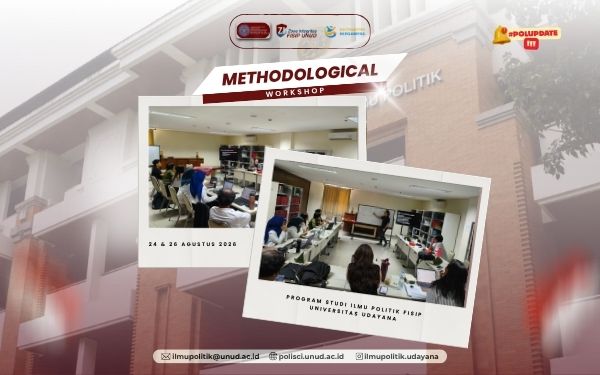
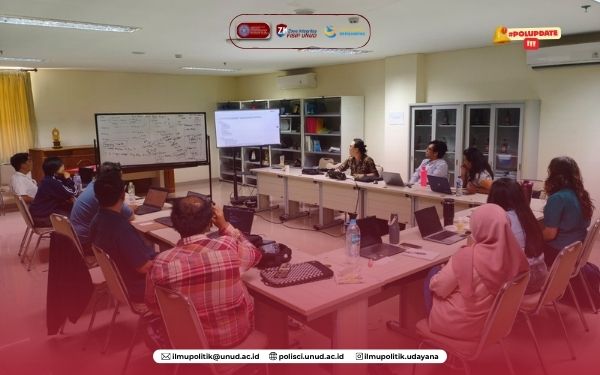
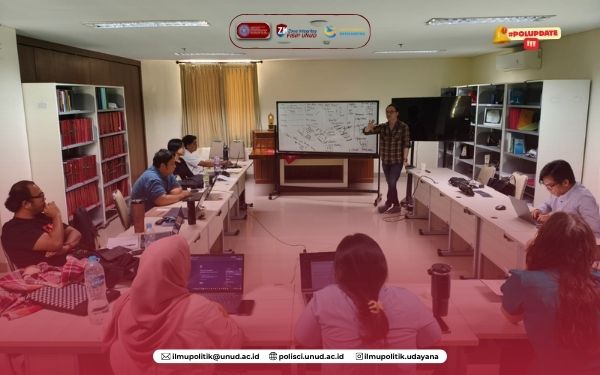
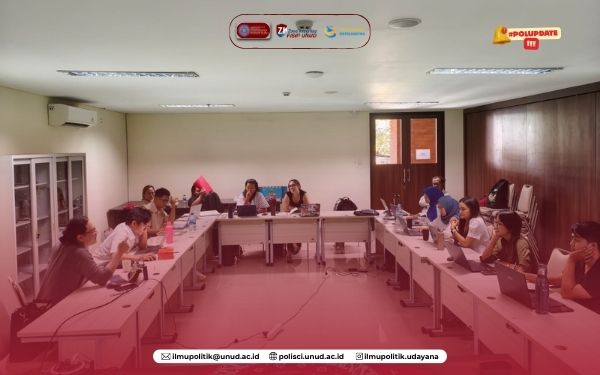
The Political Science Study Program, Faculty of Social and Political Sciences (FISIP), Universitas Udayana, successfully organized the workshop “Capital & Power: A Methodological Workshop for Social Science Research” on August 24 and 26, 2026, featuring Hizkia Yosias Polimpung from the School of Arts & Social Sciences, Monash University Malaysia.
Through this workshop, participants were encouraged to understand that methodology is never entirely neutral. The discussions explored the relationship between epistemology, methodology, and power while critically examining data fetishism, quantification, and claims of pseudo-objectivity. Participants were also invited to reflect on the importance of researcher positionality and to question: whose problems are actually being addressed through research?
The workshop also examined capital through the perspective of contemporary political economy, covering the logic of production, valorization, realization, and accumulation, as well as the processes of value extraction and commodification. Participants were encouraged to understand various forms of capital and to map monetary circuits and production constellations in analyzing social realities.
Furthermore, the discussions explored the relationship between structure and agency, emphasizing the importance of understanding social phenomena within their historical and specific contexts. A critical approach does not merely examine how a structure operates but also investigates how that structure emerged, developed, and may eventually change.
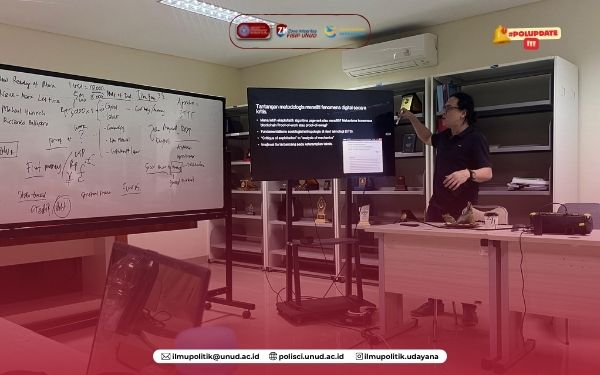
In the sessions on power, technology, and subjectivity, the workshop addressed digital capitalism, algorithms, automation, and data extraction. Participants were encouraged not to stop at simply criticizing technology or algorithms as exploitative but to develop a deeper understanding of the technical mechanisms behind code, architecture, infrastructure, and technological relations themselves.
From examining capital to critically understanding digital phenomena, this workshop provided a space to broaden perspectives on research. Research is not merely understood as an effort to explain the world, but also as a process of questioning how knowledge about the world is produced, who benefits from it, and how relations of power operate within it.
Through this activity, the Political Science Study Program of FISIP Universitas Udayana continues to promote an academic tradition that is critical, reflective, contextual, and methodologically grounded, while creating opportunities for students and academics to develop research that is more sensitive to the complexity of social realities. (Media VOX: Axel)
Gallery

FACULTY OF SOCIAL AND POLITICAL SCIENCE