 EN
 INA
Public Lecture Discusses a New Electoral Format Following Constitutional Court Decision No. 135: Looking Ahead to the 2029 National Elections and the 2031 Local Elections
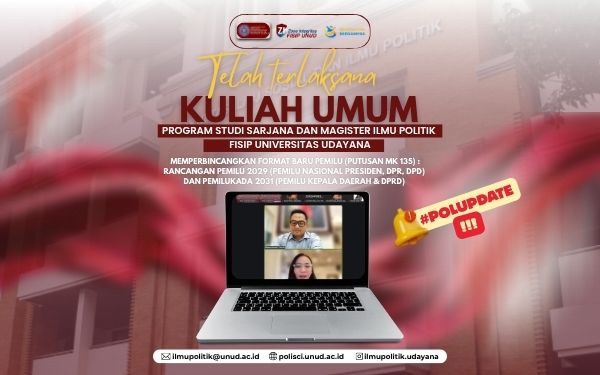
Denpasar, Monday, May 18, 2026 — The Undergraduate and Master's Programs in Political Science, Faculty of Social and Political Sciences (FISIP), Universitas Udayana, successfully held a Public Lecture under the theme:
“Discussing a New Electoral Format (Constitutional Court Decision No. 135): The 2029 Electoral Design for the President, DPR, and DPD, and the 2031 Local Elections for Regional Heads and DPRD.”
The event served as an academic forum for discussing the dynamics of Indonesia’s electoral system following Constitutional Court Decision No. 135, while also examining possible designs for the implementation of future general and local elections.
The discussion on electoral reform is particularly important for the development of Indonesian democracy. Electoral systems are not merely concerned with the technical process of selecting political leaders and representatives; they are also closely connected to the quality of political representation, government effectiveness, public participation, and the sustainability of democratic institutions.
Through this public lecture, participants were invited to explore the possibility of a new electoral format in the coming years. One of the key topics discussed was the proposed design of the 2029 National Elections, which would include the election of the President, members of the House of Representatives (DPR), and members of the Regional Representative Council (DPD), followed by the 2031 Local Elections for regional heads and members of Regional Legislative Councils (DPRD).
The separation of national and local electoral agendas opens a broader discussion on various aspects of democratic governance. These include the effectiveness of electoral stages, the quality of voter participation, the distinction between national and local political issues, and the capacity of electoral institutions to organize democratic processes more effectively.
In this context, changes to the electoral format need to be examined comprehensively. Electoral reform requires not only the readiness of election management bodies but also consideration of the preparedness of political institutions, political parties, candidates, citizens, and the regulatory framework governing Indonesia’s democratic process.
The public lecture also provided an important opportunity to strengthen a critical academic tradition in understanding contemporary political developments. Higher education institutions play a significant role as spaces for the exchange of ideas and the development of knowledge, particularly in addressing strategic issues related to the future of democracy.
Through academic discussions such as this, students are encouraged not only to understand regulatory and institutional changes from a normative perspective but also to critically analyze the political consequences of those changes. Discussions on a new electoral format therefore become part of a broader effort to understand the relationship between institutional design, political systems, representation, and the quality of democracy.
The event is expected to broaden the perspectives of the academic community regarding the dynamics of Indonesia’s electoral system and encourage the development of critical and constructive perspectives on possible political reforms in the future.
The Undergraduate and Master's Programs in Political Science at FISIP Universitas Udayana remain committed to providing academic spaces that are relevant, critical, and responsive to developments in politics and democracy at the local, national, and global levels.
The Political Science Programs extend their appreciation to the speakers, lecturers, students, and all participants who actively took part and contributed to the success of the event. It is hoped that this discussion will enrich academic perspectives and strengthen critical understanding of political developments, electoral systems, and the future of democracy in Indonesia. (Media VOX: Axel)

FACULTY OF SOCIAL AND POLITICAL SCIENCE